Egg Falls Off Roof Egg Falls and Brake Funny Photo

past Marcin Moskala
How to solve the Google recruiters' puzzle about throwing eggs from a building

There are a lot of great puzzles for programming chore interviews. My favorite one is besides known as one of the favorites amidst Google recruiters:
You work in a 100 floor edifice and you get 2 identical eggs. You need to figure out the highest flooring an egg tin can exist dropped without breaking. Find an algorithm that is minimizing number of throws in the worst-case scenario.
Nosotros can brand a few assumptions:
- If an egg doesn't break when dropped from some floor, and then it will non intermission when dropped from any lower floors.
- An egg that survives a fall tin exist used again.
- A broken egg must exist discarded.
- The effect of a fall is the same for all eggs.
- If an egg breaks when dropped, and then information technology would break if dropped from a higher flooring.
Virtually people writes some algorithms to solve this puzzle (and nosotros will practice it also), but there is actually an piece of cake solution.
Simplest respond
The simplest way to obtain the minimal floor is to throw an egg from the get-go flooring, then from the 2nd so on. This manner when the egg is finally broken so we will know that this is the floor. This is a reliable algorithm, but in the worst-case scenario information technology would take 100 throws.
The important affair to notice is that information technology is the simply reliable algorithm when you have just i egg. So you lot demand to start using this algorithm when you break the first egg.
Intuitive respond
This fashion, our kickoff egg should be used to split the 100 floors range into smaller ranges as efficiently as possible. Thus, an intuitive and popular reply is to throw the first egg from 1/n-th of the floors to check. For instance 1/3. Then the algorithm will await like the following:
- Throw the egg from 33rd floor. If it breaks, then we check the kickoff 32 floors using the 2nd egg.
- Otherwise, nosotros throw the egg from 33 + (67 * one/3) = 55th floor. If it breaks, and so we check floors 34 to 55 using the second egg.
- …
Worst example scenario for i/3 is max(33, 24, …) = 33. This way we might find a perfect n that optimizes the number of throws using some dynamic programming. This is a valuable solution that presents programming thinking, but it is non an optimal solution.
Perfect solution
To understand the perfect solution, we need to sympathize the equilibrium that is used to calculate the number of throws in the worst case scenario:

Where F(northward) is the next floor from which we throw the first egg
If we innovate following variable:

then equilibrium is following:

The optimal solution is when all arguments of this max part are equal. How practice we accomplish it? Looking from the end, the concluding D(n) is going to be one, considering we will finally go to the point where in that location is merely the single floor for the first egg. Therefore D(northward-1) should exist equal to ii because it has 1 less throw of the first egg.
Nosotros see then that the first egg should be thrown finally from the 99th floor, previously from 99–ii=97, previously from 97–3=94, ninety, 85, 79, 72, 64, 55, 45, 34, 22 and the 9th floor. This is an optimal solution! This way, we demand 14 throws in the worst case scenario (the smallest difference is xiii, merely we had to make ane extra throw on the ninth floor).
Simple equation to find the answer is following:

Where f is number of floors. This can exist simplified to:
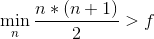
That is equal to:
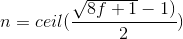
Cheque
OK, and so we have a solution and we can calculate it without any help. It is fourth dimension to cheque if information technology is correct. We will write a elementary Kotlin program for that. First, allow'southward express how to count the number of throws for some determination. When in that location are 2 or fewer floors, then we need as many throws as in that location are floors left. Otherwise we should use the already presented equilibrium:
fun maxThrows(floorsLeft: Int, nextFloor: Int): Int = if (floorsLeft <= ii) floorsLeft else maxOf(nextFloor, bestMaxThrows(floorsLeft - nextFloor) + 1) We've used here the bestMaxThrows office. It is a hypothetical office that returns a number of throws supposing that the next decisions are perfect. This is how nosotros can define it:
fun bestMaxThrows(floorsLeft: Int): Int = maxThrows(floorsLeft, bestNextStep(floorsLeft)) Again, we've just delegated the responsibility of next flooring optimization to bestNextStep role. This function gives us the best side by side step. We can define it simply — when ii or fewer floors are left, and then we will throw an egg from the showtime floor. Otherwise nosotros need to check all options and find the optimal 1. Here is the implementation:
val bestNextStep(floorsLeft: Int): Int = if (floorsLeft <= 2) 1 else (1..floorsLeft) .toList() .minBy { maxThrows(floorsLeft, it) }!! Note that this function uses the maxThrows function, so we deal with recurrence. Information technology is not a trouble, because when bestNextStep calls maxThrows, it ever calls it with a smaller value then floorsLeft (because nextFloor is always bigger than 0). Before we apply information technology nosotros will add buffering to speed up the calculations:
val bestNextStep: (Int) -> Int = memorise { floorsLeft -> if (floorsLeft <= 2) 1 else (ane..floorsLeft) .toList() .minBy { maxThrows(floorsLeft, information technology) }!!}fun maxThrows(floorsLeft: Int, nextFloor: Int): Int = if (floorsLeft <= 2) floorsLeft else maxOf(nextFloor, bestMaxThrows(floorsLeft - nextFloor) + 1)val bestMaxThrows: (Int) -> Int = memorise { floorsLeft -> maxThrows(floorsLeft, bestNextStep(floorsLeft))}fun <V, T> memorise(f: (Five) -> T): (V) -> T { val map = mutableMapOf<5, T>() return { map.getOrPut(it) { f(information technology) } }} First, we can check if information technology returns the same result every bit the 1 nosotros take calculated:
fun main(args: Array<String>) { impress(bestMaxThrows(100)) // Prints: fourteen} The answer is skilful :) Permit'south check out our next steps:
fun main(args: Array<String>) { var floor = 0 while (floor < 100) { val floorsLeft = 100 - flooring val nextStep = bestNextStep(floorsLeft) floor += nextStep print("$floor, ") }} Effect:
nine, 22, 34, 45, 55, 64, 72, 79, 85, xc, 94, 97, 99, 100,
Just how we calculated! Nice :D
Bigger picture
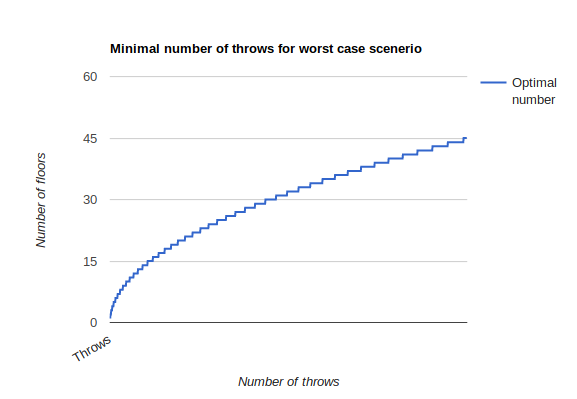
Now we have a nice algorithm that we tin apply for a lot of like bug. For example, we can change it a little to calculate the number of throws for the most probabilistic scenario. We can also check how this minimal number of throws will differ depending on the superlative of the building. Hither is a graph answering that:
Conclusion
Yous are now better prepared for your Google interview, but it is more important that yous are now improve prepared for general algorithmic thinking. This algorithm presented a nice, functional approach. A similar approach can be used for lot's of different problems in our daily jobs.
I hope that you liked it. Handclapping to say thanks and to assist others find this article. More interesting materials on my Twitter. Reference me using @marcinmoskala. If y'all are interested in Kotlin, check out Kotlin Academy and Kotlin Academy portal for Kotlin puzzlers and advanced materials.
Learn to code for gratis. freeCodeCamp'south open source curriculum has helped more than xl,000 people go jobs as developers. Get started
Source: https://www.freecodecamp.org/news/how-to-solve-the-google-recruiters-puzzle-about-throwing-eggs-from-a-building-de6e7ef1755d/
0 Response to "Egg Falls Off Roof Egg Falls and Brake Funny Photo"
Post a Comment